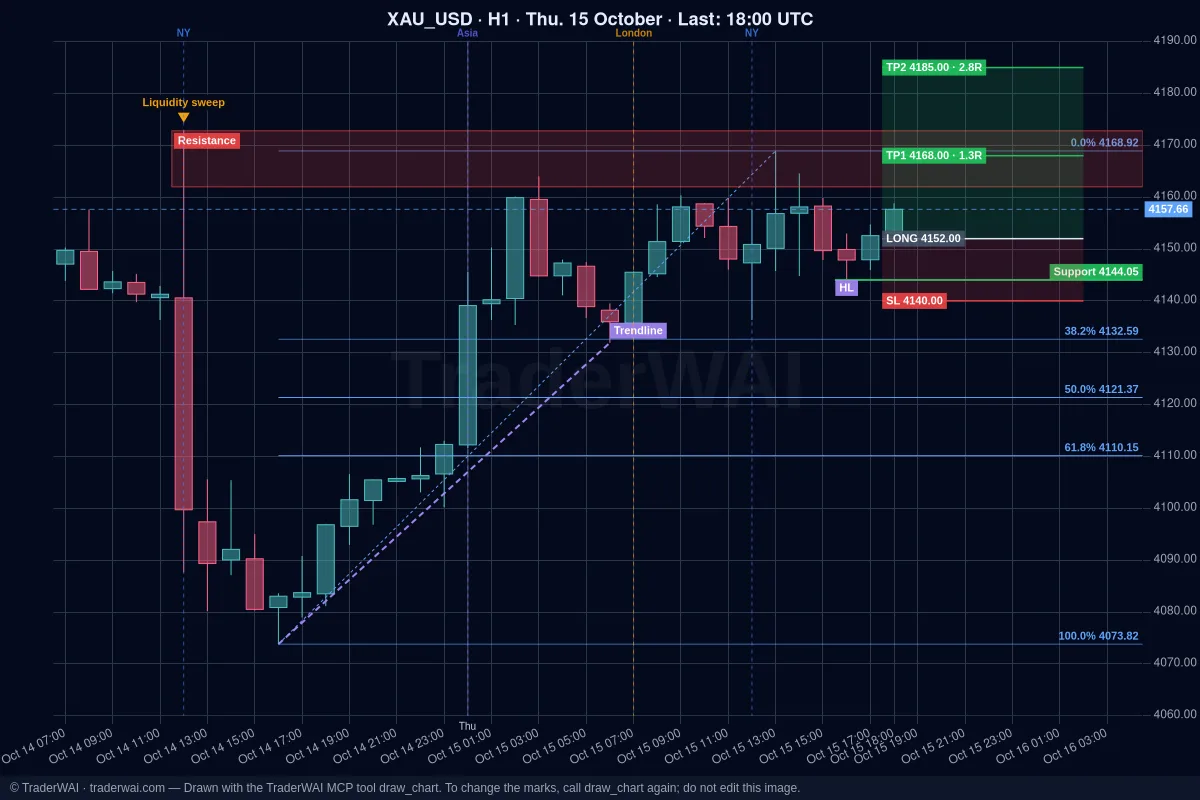
Ask ChatGPT "would buying the London breakout on EUR/USD have worked?" and, on its own, you get one of two answers: a general opinion, or a table of trades that looks precise but isn't based on real prices. A chat AI has no price history. It can write Python or Pine Script for you to run elsewhere, but it can't test the rule itself.
TraderWAI solves that. It's a connector (an MCP server) you add to ChatGPT or Claude once. After that, when you describe a strategy, your AI sends it to TraderWAI's backtest engine, which runs it on real 1-minute candles and gives back every trade. The AI explains the result; it doesn't invent it.
Step 1: connect TraderWAI to your AI
ChatGPT (every plan, Free included): on chatgpt.com open Plugins → Add → Add custom MCP server, name TraderWAI, URL https://mcp.traderwai.com, authentication OAuth, then Create as plugin and Connect TraderWAI.
Claude (every plan, Free included): on claude.ai open Settings → Connectors → Add custom connector, URL https://mcp.traderwai.com, then Connect.
Sign in with Google; the TraderWAI account is created at that moment. You don't need a broker account to backtest: the test runs on TraderWAI's data, even on a weekend.
Step 2: describe the strategy in your words
Say the market, the entry, the stop and the target, as you would to another trader:
- "Using TraderWAI, backtest EUR/USD over the last 14 days: buy when an M15 candle closes above the Asian session high, stop at the Asian low, target 2R."
- "Backtest selling gold when price sweeps the previous day's high and an M5 candle closes back below it, between 07:00 and 16:00 UTC. Stop beyond the wick, target 2R."
- "Backtest buying Nvidia on a close above the first 30 minutes' high of the New York session, stop at that range's low, close at 15:45 New York time."
Your AI turns the description into a rule and TraderWAI replays it minute by minute: it works out each day's levels, waits for the condition, opens the trade and follows it to the stop, the target or the closing time.
What you can test
- Daily levels: Asian, London or New York session high and low, the previous day's high, low or close, or any custom time range in local market time.
- Entries: candle closes beyond a level, range breakouts, liquidity sweeps, the first retest of a fair value gap, market structure (BOS, CHoCH, order blocks), at market or with a limit.
- Filters: SMA, EMA, RSI, ATR and ADX on any timeframe, time of day and day of week, and skipping high-impact news (CPI, payrolls, central banks).
- Exits: stop in pips, at a level, beyond the wick or by ATR; target in R, in pips or at a level; a closing time, or an exit on a condition such as the opposite moving average cross.
- Costs: spread, slippage and commission, if you give them, so the result is closer to what your broker would charge.
- Markets: forex, gold, silver, oil, indices, 55 US stocks, Bitcoin and Ethereum.
Step 3: read the result (and don't trust a small sample)
In a few seconds you get every trade (date, entry, stop, target, exit and the result in R and pips), the win rate, total and average R, maximum drawdown and the worst losing streak, plus the assumptions used.
Then improve it one change at a time:
- "Same test, but only if price is above the D1 EMA 50."
- "Now skip the days with high-impact US news."
- "Run it with nearby parameters too, so I can see if it only works with these exact settings."
That last request matters: a rule that only works with one exact stop or one exact target is usually fitted to the past.
Want ideas that have already been tested? The strategies page recalculates popular rules every day on the last 30 days of data.
Step 4: let the same rule watch the market
When a version holds up, ask: "Create a conditional order with this rule on EUR/USD, risking 0.5% of my balance." Conditional orders use the same engine as backtests: TraderWAI checks the rule every minute on closed candles, even with ChatGPT closed. When it fires, it sizes the trade from your risk, checks your risk limits and the order waits for your approval (unless you turned on auto-execution for that symbol). For this step you need a broker account connected, for example ChatGPT + cTrader on the Free plan.
How much history each plan includes
- Free: 5 backtests a day over the last 14 days; 1 new conditional order a day (2 active).
- Plus: 20 backtests a day over the last 6 months.
- Trader: 50 backtests a day over the last year.
- Max: unlimited backtests with all the history (2 years of 1-minute data).
There are no free trials; the first month of any paid plan is 50% off.
Common questions
Can ChatGPT backtest on its own? It can write backtest code, but it has no market data to run it on, and a "backtest" written from memory isn't reliable. With TraderWAI the calculation runs on real data and ChatGPT reads the result.
Is the data real? Yes: 1-minute candles from TraderWAI's market feed. It can differ slightly from your broker's prices, especially in spreads; live orders always use your broker's price.
Does it work in Claude, Grok or Gemini? Yes, the tool is the same in every AI. For Grok there is a dedicated guide: how to backtest a trading strategy with Grok.
Can I test a strategy from TradingView? If you can describe its rules (entry, stop, target, filters), yes. Indicators that only exist in a script, like a custom Pine indicator, can't be tested directly.